
One of the questions patients commonly ask me is:
“Is there a procedure that can help with this?”
Sometimes, the answer is yes.
For the right person, a carefully selected pain procedure can make a meaningful difference. It may reduce pain, improve movement, make sleep easier or allow someone to return to activities that have gradually become difficult.
This is the role of interventional pain medicine.
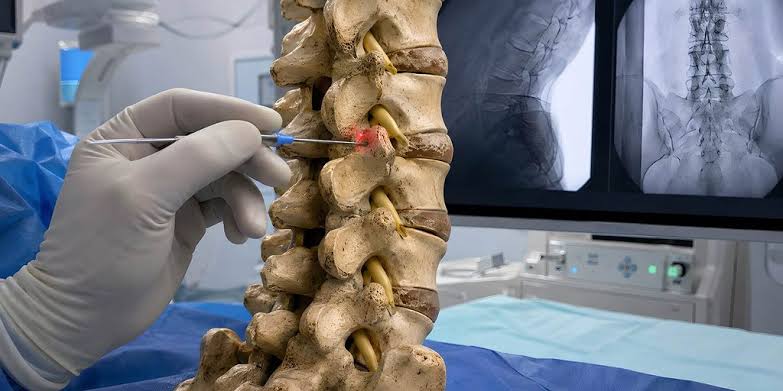
Interventional pain medicine includes treatments such as nerve blocks, spinal or joint injections, epidural injections and a range of other targeted, image-guided procedures.
The important part, however, happens before the needle ever goes in.
The first question is not simply, “What procedure can we do?”
It is:
What are we trying to treat, and is there a procedure that is likely to help?
Finding the right target
Pain can come from many different structures.
A painful joint may behave very differently from an irritated nerve. Pain arising from the spine may require a different approach from pain following surgery or an injury. Sometimes several structures may be contributing at the same time.
This is why the history, examination, imaging and previous response to treatment all matter when deciding whether an intervention is appropriate.
Some procedures can also give us useful diagnostic information.
For example, temporarily numbing a particular nerve or structure may help determine whether it is contributing to the pain. The response to that treatment can then help guide what may be appropriate next.
In pain medicine, a procedure is therefore not always simply a treatment.
Sometimes it can also help us understand the problem more clearly.
Creating a window of opportunity
I often describe a successful pain procedure as creating a window of opportunity.
Pain can make movement difficult. When movement becomes difficult, activity may reduce. Sleep can deteriorate, muscles can weaken and rehabilitation can become increasingly challenging.
If an intervention reduces pain, even for a period of time, that window can be extremely valuable.
The most important measure is not always the pain score itself, but what the reduction in pain allows you to do.
It may make it easier to walk further, sleep better, return to work, participate in rehabilitation, pick up your children, or simply get back to parts of everyday life that pain had made difficult.
The procedure may have not done all the work by itself. Rather, it has made other parts of recovery more achievable.
For some patients, the benefit may be substantial and prolonged. For others, improvement may be more modest or shorter-lived.
This is why I prefer to think about an intervention as part of a broader treatment plan rather than as an isolated event.
Will a pain procedure work for everyone?
Even when a procedure is technically performed well and there is a reasonable clinical basis for doing it, people can respond differently.
Pain is complex, and the structure we are targeting may only be one part of the overall pain experience.
That does not mean pain procedures are simply guesswork.
Careful assessment, imaging and, in some situations, diagnostic blocks can help us identify the people who are more likely to benefit.
It does mean that expectations should be realistic.
Before recommending an intervention, I consider what we are hoping to achieve.
That may include reducing pain, but it may also mean improving walking, sleep, rehabilitation, work or another activity that matters to the patient.
Those outcomes are often just as important as the pain score itself.
Balancing benefit against risk
All medical procedures carry some degree of risk.
For most image-guided pain procedures, serious complications are uncommon, but the particular risks depend on the procedure being considered, the area being treated and the individual patient’s health.
There are also situations where a procedure may technically be possible, but still not be the best option.
Other medical conditions, medications, blood-thinning treatment, infection risk, previous surgery, anatomy and the likely chance of benefit can all influence that decision.
This is where the risk-versus-benefit discussion becomes important.
The question is not simply whether a procedure can be done.
It is whether the potential benefit makes it reasonable to do for that particular person.
How often can pain procedures be repeated?
There is no single timetable that applies to every procedure or every patient.
Some interventions are performed mainly to obtain diagnostic information and may only be needed once or as part of a planned sequence.
Other treatments may be repeated when they have provided worthwhile benefit and that benefit has gradually worn off.
What matters most is the response.
How much did the procedure help?
How long did the benefit last?
Did function improve?
Was the patient able to move more freely, progress with rehabilitation or return to activities that had previously been difficult?
If a treatment has provided meaningful benefit, repeating it at an appropriate time may be entirely reasonable.
If the response was limited, that information is also useful. It may prompt us to reconsider the pain generator or choose a different approach rather than simply repeating the same treatment.
Pain procedures are tailored to the individual
Perhaps the most important principle in interventional pain medicine is that treatment is individualised.
Two people can arrive with pain in exactly the same part of the body and require completely different approaches.
One may benefit from a targeted nerve block. Another may be better suited to an epidural or joint injection. Someone else may benefit from a different type of image-guided treatment or from combining an intervention with medication and rehabilitation.
Some patients may not be suitable for a procedure at all.
That does not mean there are no treatment options.
It simply means that the approach needs to fit the person, the pain problem and the likely benefit.
For some people, a procedure may be only one part of the journey.
For others, it can provide the window of opportunity they need to move more freely, participate in rehabilitation, return to work or regain activities that pain has gradually taken away.
At The Pain Practice, interventional pain procedures are performed at Aegis Health in Murdoch and St John of God Midland Private Hospital.
The aim is always the same:
The right intervention, for the right reason, at the right time.
Best wishes

This article is intended for general information and education only. It is not a substitute for individual medical advice, diagnosis or treatment. The appropriateness of any investigation, medication, supplement, procedure or other treatment depends on your individual circumstances and should be discussed with your treating healthcare professional.